

Among the categories of crowd control equipment available to event planners and security teams, the concrete Jersey barrier occupies a role no other product fills. Where bike rack and steel crowd control barriers manage pedestrian flow and crowd pressure, concrete barriers manage vehicles. The increased prevalence of vehicle ramming incidents at public events over the past decade, combined with growing federal and municipal guidance on hostile vehicle mitigation, has elevated concrete barrier rental from a construction-zone specialty to a core element of contemporary event security planning. Understanding when concrete barriers are the appropriate choice, and when lighter alternatives suffice, is a procurement decision that increasingly defines the security posture of public-facing events.
The Specific Role of Concrete Barriers
Concrete Jersey barriers are designed to redirect or stop vehicles. The standard ten-foot section weighs approximately four thousand pounds, and the geometric profile, narrow at the top and wide at the base, redirects vehicle impact upward rather than allowing penetration. The same engineering that makes them standard infrastructure on highway construction projects makes them effective at perimeter establishment for events where vehicle exclusion is a security requirement.
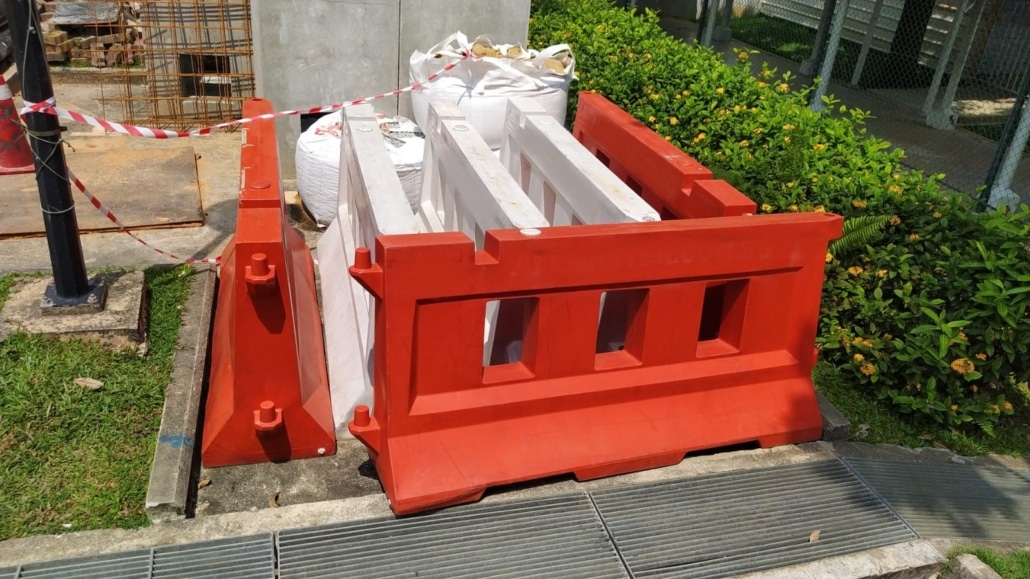
This role distinguishes concrete barriers from every other rental category. Bike rack and steel crowd control barriers are engineered for crowd loads and are not rated for vehicle impact. Plastic water-filled barriers offer some vehicle redirection capability when properly filled but cannot match the impact resistance of concrete. For genuine vehicle mitigation, particularly against hostile vehicle threats, concrete barriers are the standard.
When Concrete Barrier Rental Is the Right Choice
Several event and operational contexts justify concrete barrier deployment.
Hostile vehicle mitigation at public-facing events is the most prominent contemporary use case. Marathons, festivals, parades, public gatherings, and other events that congregate large pedestrian crowds in open or semi-open environments increasingly include concrete perimeters at vehicle access points along the event footprint. Federal guidance from agencies including the Department of Homeland Security and the Cybersecurity and Infrastructure Security Agency identifies vehicle ramming as a persistent threat vector and recommends physical mitigation as a core element of event security planning.
Construction zone protection on roadways and infrastructure projects remains the original application and continues to drive substantial rental volume. Concrete barriers separate active work zones from traffic, protect crew safety, and redirect errant vehicles away from open excavation, equipment, and personnel.
Municipal applications include road closures, demonstration management, perimeter establishment at government facilities, and emergency response operations. Concrete barriers also serve in temporary security perimeter establishment around dignitary events, conferences with heightened threat profiles, and similar contexts.
Industrial and commercial perimeter control rounds out the category, including facility protection, vehicle exclusion at sensitive sites, and temporary infrastructure during construction or operational transitions.
When Lighter Alternatives Are Sufficient
Concrete barrier rental is operationally significant. The equipment requires heavy transport, crane or forklift placement, advance site planning, and recovery logistics that exceed what bike rack or plastic barriers require. For events without genuine vehicle threat profiles, particularly indoor events, heavily controlled venues with existing perimeter security, and contexts where vehicle access is already restricted by infrastructure, lighter equipment is often sufficient.
The procurement decision should be driven by an honest threat assessment rather than reflexive specification. A threat assessment that concludes vehicle mitigation is necessary justifies the operational complexity of concrete barriers. An assessment that concludes pedestrian flow management is the actual requirement points to lighter alternatives at substantially lower cost and complexity.
Logistics and Site Planning
Concrete barrier deployment requires substantially more advance planning than other crowd control equipment categories. Delivery requires flatbed transport with appropriate weight capacity, placement requires crane or heavy forklift equipment, and access routes must accommodate the transport vehicle. Site plans must specify exact placement, including barrier orientation, connection points if interlocking units are specified, and gaps for authorized access.
Recovery follows a similar logistical profile and must be scheduled into the event timeline rather than treated as an afterthought.
Specifications and Configuration
Standard Jersey barriers are typically ten feet in length, thirty-two inches in height, and weigh approximately four thousand pounds. Variations exist for specific applications, including taller F-shape barriers, interlocking systems with mechanical connection between units, and specialized hostile vehicle mitigation barriers tested to specific impact ratings such as the ASTM F2656 standard. For events with specific impact rating requirements, the test certification of the equipment should be verified during procurement.
A well-planned concrete barrier deployment is an investment in the kind of perimeter security that allows an event to proceed without an entire category of catastrophic risk. For event planners, municipal agencies, security teams, and venue operators building security postures appropriate to the contemporary threat environment, Epic Crowd Control provides concrete barrier rental, vehicle mitigation planning support, and the logistics coordination required to deploy heavy perimeter equipment effectively within event timelines.
