

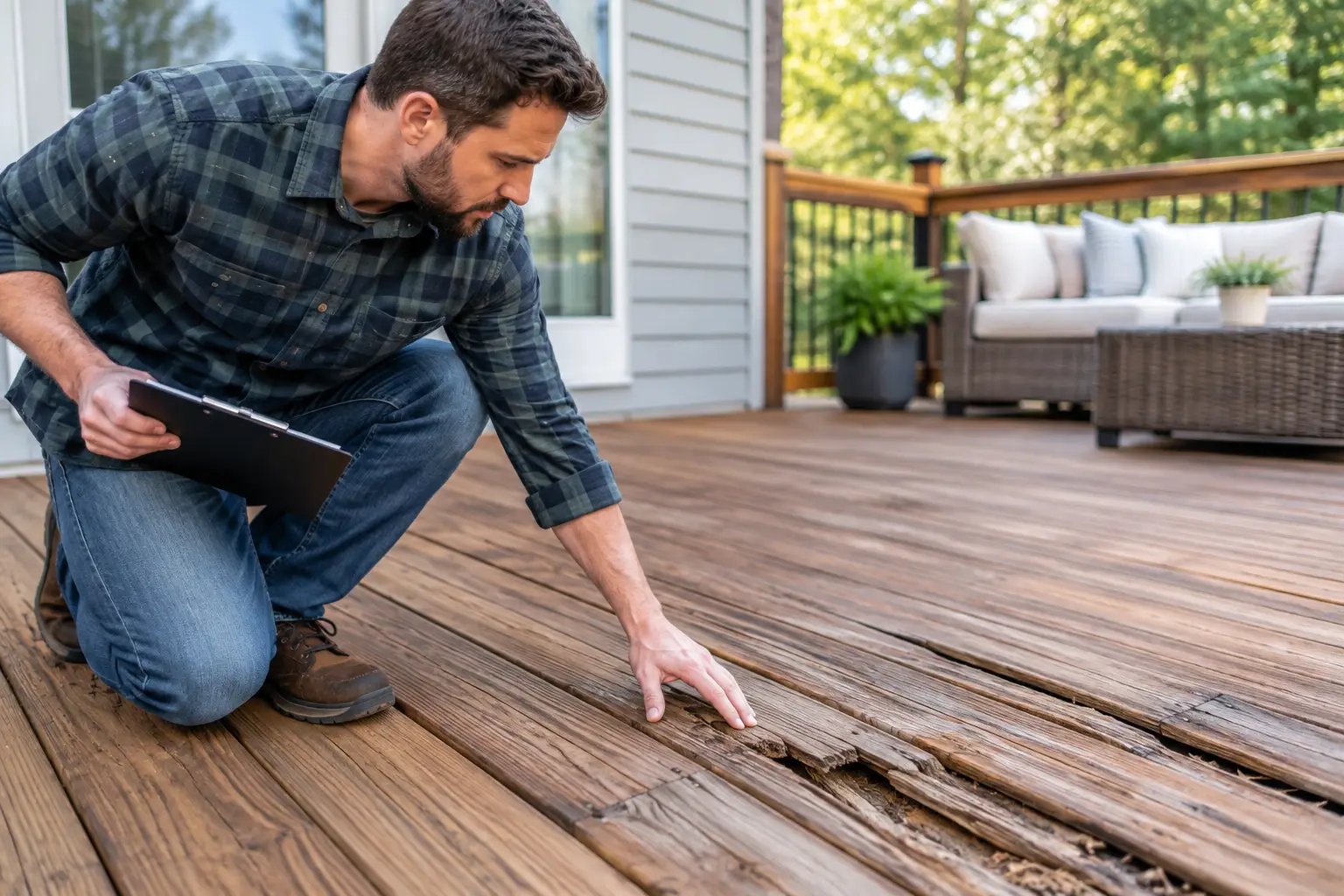
Some deck damage is cosmetic, and some is structural. Telling the two apart determines what a repair is worth. An assessment needs to consider the supporting frame as well as the visible boards. The signs that matter sit at or below the board surface, and each one leads to a different conversation with a professional.
Start below the boards
Deck boards are the wearing surface. The joists and bearers underneath carry the load. Laying new boards over a rotting subframe wastes the new material and leaves the hazard in place.
Most subframes use H3 or H4 treated pine, which resists decay and termites. Treatment slows deterioration, but it doesn’t stop it. Ground moisture and poor drainage still reach the frame over time.
How well a subframe is ventilated determines how fast it ages. A deck built low to the ground with blocked airflow stays damp after rain. Damp framing timber decays years before the boards above it show wear.
Bearers near soil face the highest risk. Treated pine resists decay, and constant ground contact still shortens its life. Posts in stirrups above ground outlast posts buried in it.
Warning signs appear from above. A deck that bounces underfoot has movement in the frame. A sagging line across the boards points to a failing bearer. Boards lifting at their fixings often mean the joist below has softened.
A professional inspection goes underneath. The frame gets probed at ground contact points, along bearers, and at every joist end. AS 1684 sets the framing requirements for residential timber construction, and the existing structure gets measured against it. That check comes before any quote for new boards.
Surface weathering or true rot
Sun and rain silver the surface of timber decking. That gray film is UV damage to surface fibers, and it stays cosmetic. Sanding and a fresh coat of decking oil bring the color back.
Rot is a different problem. Wet rot develops where timber stays damp, and the wood softens and darkens. Dry rot is a fungal decay that leaves timber brittle and cracked.
Wet rot stays where the moisture is. Dry rot can travel through timber and across to neighboring boards. Either one in the frame is a structural finding.
The screwdriver test separates sound boards from failed ones. Press the tip of a screwdriver into the board with firm hand pressure. Sound timber resists the point, and rotted timber lets it sink in.
Test where water lingers. Board ends, fastener holes, shaded corners, and timber near the ground all fail first. Softness is a reason to have the board assessed, because it can mean the board has lost its strength.
Decking oil and sealers slow both kinds of damage. A sealed board sheds water and resists UV. An unsealed board absorbs both, and decay starts sooner.
Boards that fail the screwdriver test across wide areas belong on the replacement list. Isolated soft spots can sometimes be cut out and patched. Widespread softness cannot.
Signs of termite damage
Termites hollow timber from the inside. A board can look sound and hold almost nothing. Australian conditions favor termite activity, and a deck offers concealed timber close to the ground.
The signs stay consistent. Boards that sound hollow when tapped have lost their core. Mud tubes along the subframe or posts mark active movement. Sagging sections show where the frame has been eaten out.
Check the posts and the subframe wherever timber sits near soil. Termites enter at ground contact points. Post bases and stirrups need a close look during any inspection.
Annual inspections suit decks in termite-prone regions. Checking the subframe with a torch can catch activity before the boards show it.
Pest treatment comes before carpentry. New boards installed over an active infestation get attacked in turn. A licensed pest inspector confirms whether activity is current or historic. Old damage still needs a structural check, because hollowed timber carries less load.
Only after treatment and assessment does board replacement make sense. Skipping that order repeats the damage within a few seasons.
Cupping, warping, and splitting
Boards deform when moisture reaches one face faster than the other. Cupping curves the edges upward as the top face dries. Warping twists the board along its length. Splitting opens cracks along the grain, usually near the fasteners.
Poor ventilation under the deck drives most cupping. The underside stays damp while the sun dries the top. The imbalance pulls the board out of flat, and intense UV on unsealed timber speeds the process.
Airflow under the deck prevents most of it. Clearing blocked vents and debris lets the underside dry. A board that dries evenly stays flat.
Minor cupping can be fixed by re-fastening. A screw through the high edge can pull a slightly cupped board flat. The board must still be sound enough to hold the fixing.
Severe cupping is a different case. The board holds water after rain, and the raised edges catch shoes. Fixings no longer sit flush, and the surface becomes a trip hazard.
Splits near fastener lines weaken the board’s grip on the screw. Under load, a split board can lift along the crack. Boards with deep splits or hard twists go on the replacement list.
Cupping beyond a few millimeters rarely settles back. Once the board has taken a set, replacement is the reliable fix.
What loose fasteners mean
Popping screws and rusted nails usually signal a timber problem. Screws rise when rot softens the wood around the hole. The thread loses its grip, and the board works loose underfoot.
Re-driving a screw into softened timber holds only briefly. The hole stays soft, and the screw works up again. A board that won’t hold a fixing has failed timber around the connection.
Corrosion adds a second problem. Rusted fixings stain the boards and lose section as they waste away. Black streaks around a nail head often mark decay in the surrounding wood.
Fastener choice matters near pools and coastal air. Galvanized fixings corrode faster in those conditions. Stainless steel costs more and lasts longer in wet exposure.
Check stairs and deck edges first. Loose boards at a step nose or a walkway edge are trip hazards. Those boards go to the top of the replacement list whatever their appearance.
A professional can separate movement damage from rot during one visit. Boards expand and contract through the seasons, and undersized fixings work loose on their own. Identifying the cause determines the fix.
Choosing replacement boards
The choice of material sets the maintenance load for the next twenty years. Premium hardwoods like Jarrah and Spotted Gum bring high density and natural durability. They still weather without regular oiling, and they cost more up front.
Capped composite decking wraps a wood-plastic core in a protective shell. The shell resists moisture and UV without sanding or oiling. Composites suit owners who put low maintenance ahead of natural grain.
Hardwood asks for oil once or twice a year in harsh sun. Composite asks for washing. Neither tolerates a rotting subframe.
Match the material to the exposure. Full sun punishes unsealed timber. Pool surrounds need slip resistance and tolerance of constant wetting. Shaded decks stay damp and favor rot-resistant species.
Spot repairs add a matching problem. New hardwood beside weathered boards shows a color line for seasons. Composite ranges change profiles and colors, so old lines can be hard to source.
How a board performs depends on the climate, so buy for local conditions. Compare hardwood and composite options in a supplier’s range, such as Decking Supplies in Perth, before ordering.
Repair or resurface: assessing the scope
With a material chosen, the scale of the job sets the budget. When failed boards are few and the subframe is sound, spot replacement works. The sound boards stay, and the failed boards come out.
With widespread deterioration, full resurfacing may offer better value. Mixing new boards with weathered ones gives uneven color and uneven wear. A larger decking supplies order once beats years of repeat labor.
The deck’s age changes the calculation too. A deck where most boards sit near the end of their service life will keep producing failures. Before replacing a fifth of the boards this year and another fifth next year, compare quotes, including repeat call-outs, against a single resurface.
Get the real percentage before deciding. A moisture meter and the screwdriver test map how far the damage runs. Surface checks alone undercount the failures, so the wrong scale gets chosen.
When the job needs a licensed builder
Some deck work crosses from carpentry into structural building. Elevated decks, stairs, balustrades, and pool surrounds carry load and safety obligations. A professional assessment establishes the appropriate scope of that work and any documentation worth discussing before it begins.
Balustrades and stairs must meet set heights and load strengths. A builder works to those requirements and documents the compliance. Unpermitted structural work can complicate insurance claims and future sales.
Check the ledger board with the same care as the frame. It ties the deck to the house, and its detachment is a leading cause of deck collapse. Corroded bolts, missing flashing, failed joist hangers, or rot at the wall line all warrant a professional look.
Footings belong in the same assessment. Stumps and stirrups corrode and settle over time. A level check across the deck surface reveals movement below.
Pool surrounds bring their own barrier rules. Height and gap requirements apply to fencing and gates near the water. Those rules sit outside general carpentry.
Permit rules vary between local authorities. A licensed builder confirms what applies before work starts. That step protects the owner and everyone who uses the deck.
The sequence stays the same on every deck. Inspect the frame first, then test for rot and termites. Measure the damaged share, and choose materials for the exposure. Boards that pass keep their place, and boards that fail come out. A professional assessment turns that list into a scope of work, and for any deck showing several of these signs, that assessment is the next step.
