

Access to safe drinking water is a basic requirement in every workplace. Whether it is a corporate office, educational institution, healthcare facility, or manufacturing unit, the quality and availability of drinking water directly influence employee well-being and day-to-day operations. However, selecting a commercial water purifier involves more than comparing capacities or prices; water quality, consumption patterns, maintenance requirements, and future scalability. All of them play an important role in determining the most suitable solution.
In some cases, a standalone purification system may be sufficient. However, larger facilities such as multispeciality hospitals or educational campuses may require an RO plant to meet continuous demand. Understanding these factors can help businesses invest in a system that delivers reliable water quality without unnecessary operational costs.
Factors to Consider Before Choosing the Right Commercial Water Purifier
There are certain factors to consider before choosing the right commercial water purifier such as:
- Daily Water Consumption and Number of Users
The water requirement of an office depends on employee strength, visitor footfall, and usage throughout the day. Workplaces with cafeterias or multiple shifts generally consume more water than standard offices operating 9 to 5.
For instance, an average adult consumes approx 3-4 litres of water.
Offices with 50-70 people: May require 25LPH (litres per hour) of water.
Offices with 110-160 people: May require 50 LPH of water.
Offices with 220-270 people: May require 100 LPH of water.
Selecting the right capacity can help prevent shortages during busy hours.
- Existing Water Quality and Source
The quality of incoming water determines the type of treatment required. Municipal water, borewell water, and tanker water differ in their mineral content and impurity levels. For instance, municipal water may have moderate total dissolved solids (TDS) levels, whereas borewell water may have high TDS concentration.
Getting your water tested can help you choose the right commercial water purifier.
- Suitable Purification Technology
Different purification technologies target different impurities such as:
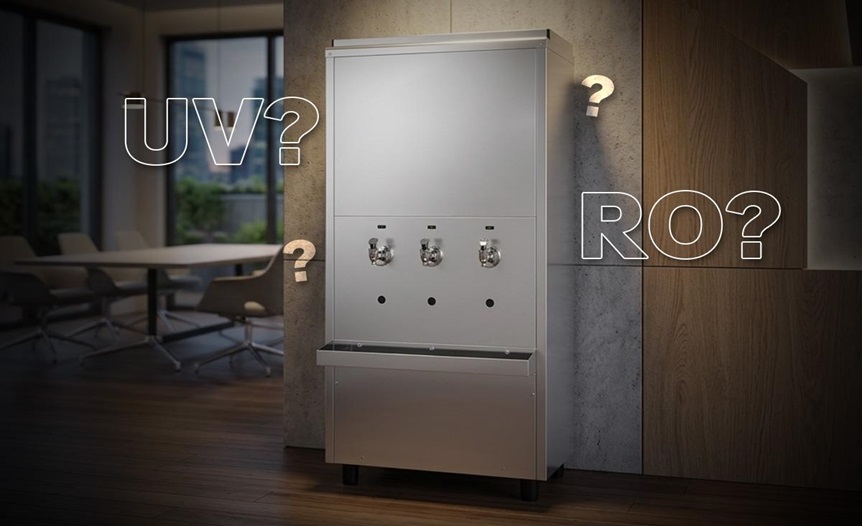
Reverse osmosis (RO) removes dissolved salts, while UV and UF systems target microorganisms and suspended particles.
Choosing a commercial water purifier with the required purification technology can help ensure a consistent supply of purified water.
However, many modern commercial water purifiers come with multi-stage filtration, which can help target different kinds of impurities at the same time, without relying on external purifier setups for different impurities.
- Maintenance Requirements
Regular maintenance is necessary to preserve water quality and maintain system performance. Filter and membrane replacement intervals vary depending on water quality and daily usage. Choosing a system with simple maintenance requirements can reduce downtime and improve operational efficiency.
- After-Sales Support
Availability of post-sale support is one of the factors that should be prioritised by businesses, as delays in servicing can affect water availability and disrupt workplace routines. Select a manufacturer with dependable after-sales support that can help maintain the performance and extend the lifespan of the commercial water purifier.
- Compliance with Water Quality and Safety Standards
Commercial establishments, such as corporate offices and educational campuses, cater to a large number of people and hence should prioritise systems that meet BIS compliance. Beverage industries such as cafes and restaurants need to have FSSAI compliance as well.
Conclusion
Selecting the right commercial water purifier requires careful consideration of different factors such as water quality, demand, operating costs, and long-term requirements. A well-planned system not only provides safe drinking water but also supports efficiency and reliability in the workplace. Considering these factors before making a decision helps organisations choose a solution that remains effective and sustainable as their needs evolve.
